

Online Showroom: What It Is, Platform vs Custom Build, and Costs
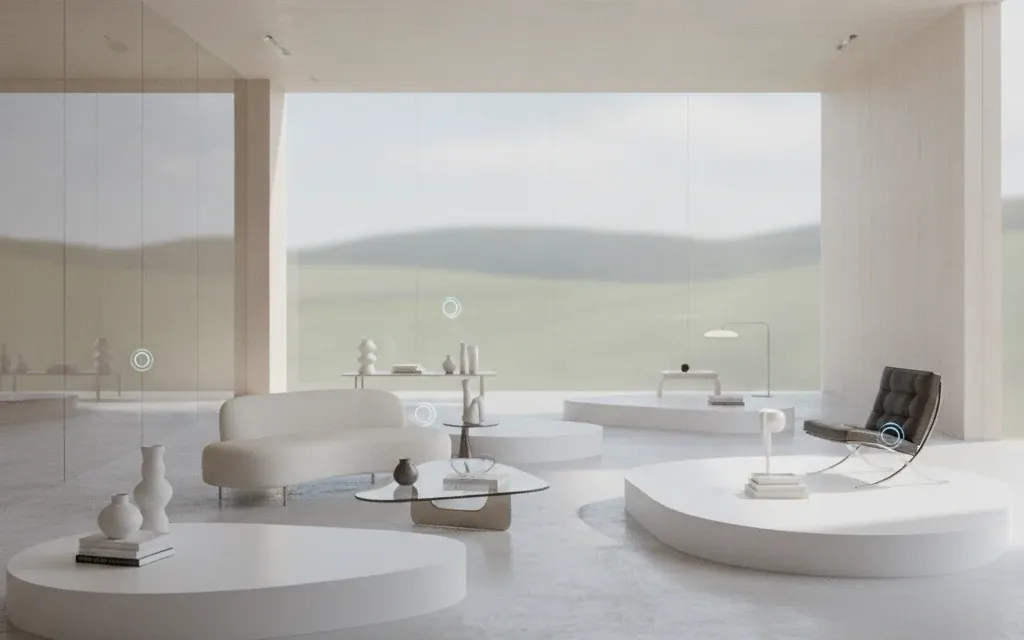
An online showroom is a 3D space in a browser where customers walk your products instead of scrolling them: the digital version of a trade stand, a flagship store or a wholesale showroom. There are two ways to get one. You can rent a templated space from a SaaS platform and be live in weeks, or commission a custom build you own outright. Which is right depends on three things: your deadline, how much the showroom has to feel like your brand, and whether you are renting a channel or building an asset.
What is an online showroom?
The names circle one idea. Online showroom, virtual showroom, digital showroom and virtual storefront all describe a navigable 3D environment, usually running in an ordinary browser, where a visitor moves through a branded space and interacts with products: opens a hotspot, spins a model, watches a film, follows a link to a product page. Digital showroom often carries one extra shade of meaning, a digital twin of a physical space you already have, so the trade-show stand or the flagship keeps selling after the doors shut.
What separates a showroom from a product-grid website is the walk. A grid is efficient and forgettable; a space tells a story about the brand in the way a physical showroom does, with adjacency, lighting and pacing. That is why the format took hold first in fashion wholesale and furniture, categories where context sells the product.
What does an online showroom actually change for a brand?
Three practical things. It removes the calendar: a wholesale buyer in another timezone walks the collection at 2am without a flight or an appointment, and the space works every week of the year rather than the four days of the fair. It removes the per-event build cost: a physical trade stand is rebuilt and thrown away per show, while an online showroom is built once and updated per season. And it extends reach without extending headcount, because the showroom does the first meeting on its own; the sales call happens with a buyer who has already walked the range.
Browser, headset or AR: how people reach it
Under both the rent and build routes sits a delivery choice that decides your audience.
Browser (WebGL). The showroom runs in an ordinary web page on desktop or mobile, no app, no headset. It is the default for a reason: a buyer opens a link and is inside. Custom builds like ours run on Babylon.js for exactly this reach.
VR headset. More immersive, and a strong fit for a controlled setting, a wholesale suite or an event, where the hardware is provided. As the primary public channel it fails, because your audience does not own headsets.
AR. A single product placed in the viewer's real space through a phone. It is a companion on product pages rather than a whole showroom, and it is built from the same 3D assets.
For a showroom meant to be opened cold by a buyer or a customer, the browser is the product; VR and AR are additions for specific settings.
Platform or custom build: which do you need?
The platforms are real businesses solving a real problem. NuORDER and JOOR run wholesale showrooms for fashion; ByondXR and rooom sell templated immersive spaces; Zolak and Tailoor cover furniture and apparel. Renting from them is fast and the entry cost is a subscription, and for a brand that needs a showroom live for next month's buying season, that is the right call. The trade-offs are the ones renting always has: your space is built from the same kit as everyone else's, customisation stops where the template does, and you stop having a showroom the day you stop paying.
A custom build inverts every one of those. We build ours on Babylon.js, the open-source 3D engine, which means the space is designed from zero around the brand, behaves exactly as designed, and is owned outright like a website rather than rented like a booth. It costs more and takes longer, so the honest filter is simple: if the showroom is a channel among many, rent one; if the showroom is meant to be your flagship, the thing people remember and come back to, build it. Our virtual showroom development page covers how we run these projects.
Which sectors it fits
The format took hold first where context sells the product, and the list has widened from there.
Fashion wholesale. The original driver: buyers walk a season's collection as a space instead of a linesheet, which is why NuORDER and JOOR exist.
Furniture and interiors. Large, configurable, sold on how a piece sits in a room, with kitchens and bathrooms in the same bracket.
Automotive and equipment. Expensive and configurable, impossible to floor every variant physically, so a configurator in a branded room does what the physical space cannot at scale.
Building products. Tiles, surfaces and lighting a specifier wants to see applied, at scale, in context. The thread is not the sector but the decision: if seeing the product in 3D, in context, changes whether someone commits, the category fits.
What does an online showroom cost?
Platform pricing is a subscription and varies by vendor and catalogue size; the entry point is low, which is the point of the model. A custom build is priced per project: ours start from around 20,000 pounds depending on the size of the space and the depth of interaction, plus a monthly fee for hosting and traffic. The number moves with three levers: how large the space is, how much of the catalogue is modelled in true 3D rather than presented as imagery, and how deep the integration goes, from simple links out to product pages up to connecting your existing checkout.
You can see the format working in our interactive virtual store case study, and the furniture-specific pattern in our virtual furniture showroom guide.
Your stand, still selling after the show
One use case is worth pulling out on its own, because it changes the maths. If you already invest in a physical trade stand or a flagship showroom, a digital twin turns that one-off spend into a year-round asset. The stand you build for four days of a fair is photographed, thrown away and rebuilt next season; a digital twin of the same design keeps selling the other 361 days, to buyers who could not attend, in every timezone.
That reframes the cost. Set a custom build next to the annual, repeated cost of physical stands rather than against a software subscription, and a space you own outright and update per season starts to look like the cheaper line over a couple of years, not the expensive one. It is the clearest case where commissioning beats renting: the showroom is not an extra channel, it is the durable version of a cost you already carry.
Where we stand, honestly
Custom online showrooms are a service we are actively building, not a decade-old production line, and we would rather say so than oversell. We have shipped demo storefronts and a virtual furniture showroom, the category itself is proven by the biggest names in retail, and the deeper e-commerce integration (live pricing and checkout from inside the 3D space) is still maturing across the whole industry, not just for us. If a template genuinely does the job for your catalogue, we will tell you to rent the template.
Walk one
Our interactive virtual store runs the whole idea in a browser. Open the live build here before you decide between renting and commissioning; the format reads better walked than described.
Frequently Asked Questions
Is an online showroom the same as a virtual showroom?
Yes. Online showroom, virtual showroom and virtual storefront are the same product described from different angles. Digital showroom sometimes specifically means a digital twin of a physical space, but in practice the four terms are used interchangeably.
Do customers need a VR headset or an app?
No. A well-built showroom runs in an ordinary browser on a laptop or phone, because anything that needs a download will not get used. A headset version can be added for showroom or event use, but the browser is the product.
Can an online showroom connect to my existing store?
Yes, at different depths. The simple, reliable pattern is hotspots that link to your existing product pages and checkout. Deeper integration, live pricing and cart inside the 3D space, is possible and is the part of the category still maturing industry-wide.
How long does a custom online showroom take to build?
Longer than renting a template, which is live in weeks. A custom build is a design and development project: scope it like a website build with a 3D production layer on top, not like a photo shoot.
Which industries get the most out of one?
Fashion wholesale and furniture led, and the pattern extends to automotive, building products and any range that is considered, configurable or hard to show in a flat photo. Cheap, simple, low-variation catalogues get little from it.
What does a custom online showroom cost?
Ours start from around 20,000 pounds plus a monthly hosting and traffic fee, scaling with the size of the space, how much of the catalogue is true 3D, and how deep the store integration goes. A platform subscription is cheaper up front and rented rather than owned.
Do we own a custom build?
Yes. A custom showroom deploys on your own domain and is yours like a website. A platform showroom lives in the vendor's system and ends with the subscription.
Sources
- Showroom, Wikipedia (accessed 2026-07-07)
- Babylon.js, Babylon.js (accessed 2026-07-07)
- Digital Showroom, rooom (accessed 2026-07-07)